
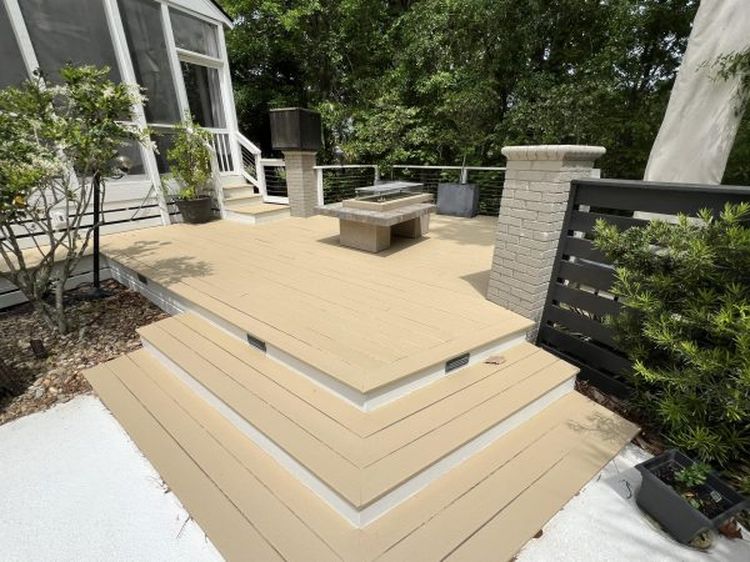
Your deck needs a fresh finish. The contractor quote shows two paths: traditional deck paint at $2-$4 per square foot, or a polymer deck coating system at $8-$12 per square foot. Same deck, very different surfaces, and a 4-5x price gap. The next question every homeowner asks: is the polymer system actually worth it?
This comparison breaks down deck coating vs paint on the only metric that matters long-term — total cost of ownership over the deck's life — plus the durability, appearance, water resistance, and warranty differences that drive the math.
Key Takeaways
- Deck paint averages 2-4 year lifespan before peeling and re-coat; polymer coatings average 12-20 years.
- Total 15-year cost: paint with re-coats ≈ $25/sqft vs polymer ≈ $10-12/sqft — polymer is cheaper despite higher upfront.
- Paint still makes sense for low-traffic decorative decks or short-term holds (selling within 2 years); polymer wins everywhere else.
Side-by-Side Performance
Lifespan
Traditional deck paint on a horizontal surface in normal sun-and-rain exposure fails at year 2-4. Failure looks like flaking, peeling around fasteners, hairline cracks where boards expand and contract differently than the paint film. Polymer deck coatings — the engineered systems like 3D Deck Defense — bond chemically to the substrate, flex with thermal and moisture cycles, and carry manufacturer warranties of 10-15 years. Real-world lifespan often runs longer than the warranty when properly installed.
Water Resistance
Paint forms a film that's only as water-tight as its weakest crack. Once paint cracks (year 2-3 typically), water gets under the film, accelerates wood rot, and forces water out as new bubbles each rain. Polymer coatings form a seamless monolithic membrane — no cracks, no edges, no entry points for water. This is especially decisive for pool decks, lakeside docks, and rainy-climate installations where water intrusion is the #1 destroyer of substrate.
UV Resistance
Most deck paints fade noticeably within 12-18 months in full sun, with color shift accelerating in years 2-3. Premium paints help marginally. Polymer coatings include UV stabilizers engineered for outdoor exposure — color and gloss hold for the entire warranty period in most cases. For decks with hours of direct sun exposure, this is a major durability gap.
Traffic and Abrasion
Paint scuffs and scrapes — a chair drag, dog claws, a misplaced grill foot all leave visible damage. Polymer coatings include aggregate or texture that grips surface particles into the cured layer, making them measurably more abrasion-resistant. Heavy-traffic decks (pool decks, outdoor kitchens, deck-as-second-living-room setups) are where the durability gap shows fastest.
Slip Resistance
Wet painted decks are notoriously slippery. Polymer systems include slip-resistant aggregate options that maintain grip even when wet — important for pool decks, dock surfaces, and any deck used by older adults or kids.
Total Cost of Ownership Over 15 Years
Sticker price is misleading. Here's the actual math for a typical 400 square foot deck:
Deck Paint Path
- Year 0: Initial paint installed — $1,600 ($4/sqft)
- Year 3: Strip + re-paint after first failure — $2,800 ($7/sqft including prep)
- Year 6: Strip + re-paint — $2,800
- Year 9: Strip + re-paint — $2,800
- Year 12: Strip + re-paint — $2,800
- 15-year total: $12,800 (~$32/sqft over 15 years)
Polymer Coating Path
- Year 0: Polymer coating installed — $4,000 ($10/sqft)
- Years 1-15: No re-coat required (within 10-15 year warranty)
- Optional: light touch-up at year 10 — $400-$800
- 15-year total: $4,000-$4,800 (~$10-12/sqft over 15 years)
The polymer system pays back inside year 5 versus the paint re-coat cycle. Beyond year 5, every additional year is pure savings. Over 15 years, polymer total cost is roughly one-third the paint total.
When Paint Still Makes Sense
Polymer coatings aren't universally the right answer. Paint wins in three specific scenarios:
- Short-term holds. Selling the house in under 2 years? Paint refreshes appearance for less upfront. The long-term math doesn't matter if you won't be there.
- Decorative-only decks. Front porch deck that never sees traffic? Paint lasts longer on these because the failure mechanism (foot traffic + chair drag) isn't present.
- Specific color requirements. Paint comes in unlimited colors; polymer systems typically offer a curated palette of 8-15 colors. If you need a specific custom color match, paint may be the only option.
What to Ask Before You Choose
1. How many years do you plan to own this home? Under 3 years, paint may be fine. Over 5 years, polymer math wins.
2. How much traffic does the deck see? Pool decks and high-use entertainment decks need polymer. Decorative front porches tolerate paint.
3. What's the climate? Hot-dry (Phoenix), cold-wet (Pacific NW), freeze-thaw (Midwest), and coastal (Gulf Coast, Atlantic) all favor polymer.
4. What's the substrate condition? Polymer requires sound substrate; rotted or split boards need repair first. If your deck needs major substrate work, factor that into both quotes.
5. Is a warranty included? Reputable polymer installers provide 10-15 year written warranties; paint typically comes with no warranty beyond the paint manufacturer's product warranty.
What is the longest-lasting deck finish?
Engineered polymer coating systems — the category 3D Deck Defense competes in — outlast every other finish category by 5-10x. Manufacturer warranties run 10-15 years; real-world lifespan often exceeds 20 years when professionally installed and maintained.
Can you paint over a deck coating, or coat over deck paint?
Painting over a cured polymer coating is possible but defeats the purpose — you've now introduced paint failure modes back into the system. Coating over old paint usually requires complete paint removal first; most polymer manufacturers void warranty if installed over existing paint. Strip, prep, and apply on bare or properly primed substrate.
How long does deck paint actually last in real-world conditions?
Manufacturer claims often say 5-7 years; real-world performance on horizontal deck surfaces under normal use ranges 2-4 years before noticeable failure. Vertical surfaces (railings, fascia) last longer because water doesn't pool on them.
Is a polymer deck coating waterproof?
Yes — seamless polymer coatings are fully waterproof when properly installed. This makes them the standard choice for dock surfaces, pool decks, second-story deck-over-living-space installations, and any application where water intrusion to the substrate would cause major damage.
Need a Side-by-Side Estimate for Your Deck?
The right answer depends on your specific deck — substrate, climate, use pattern, and how long you plan to own the home. Generic comparisons help frame the decision; a specific estimate lets you make it.
Get a written assessment from a 3D Deck & Dock Defense Specialist who'll evaluate your substrate condition, recommend the right system for your use case, and quote both options if you want the comparison. The 15-minute on-site visit costs nothing and gives you actual numbers instead of estimates pulled from a national average.