
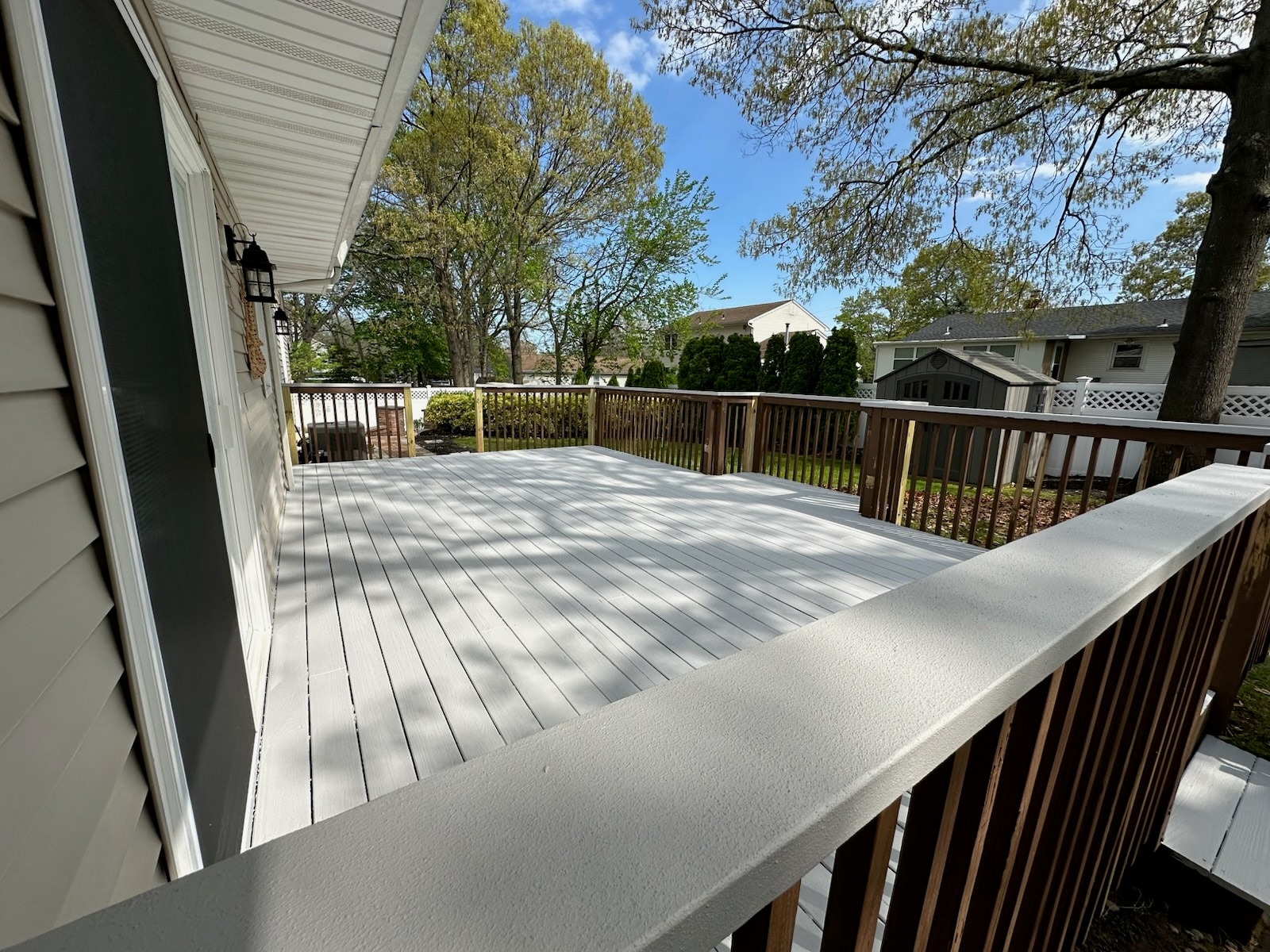
Your deck is the largest exposed wood surface in your backyard. Every gallon of rain, every UV-soaked summer afternoon, every patio chair drag attacks it. The decision you make about what goes on top of that wood determines whether you refinish every two years or every fifteen.
This guide walks through how to choose the right deck surface — the four real options homeowners face, the conditions each one performs best in, and the trade-offs nobody mentions until you're three years into the wrong choice.
Key Takeaways
- Paint covers grain and looks great year one — but cracks, peels, and traps moisture by year three on most decks.
- Semi-transparent stain lets wood show through with 2-4 year reapplication cycles; clear sealer protects but barely changes appearance.
- Polymer deck coatings (the 3D Deck Defense category) outperform paint and stain by 5-10x lifespan and resist water, UV, and traffic without re-coating.
The Four Real Deck Surface Options
Option 1: Paint
Paint forms a film on top of the wood that hides grain entirely. It's the cheapest entry point and gives the boldest color range. The catch: paint expands and contracts differently than wood, so by year two or three you typically see cracking, peeling, and flaking — especially on horizontal surfaces where water pools and freeze-thaw cycles hit hardest. Once paint fails on a deck, removal becomes the expensive part: stripping, sanding, and prepping for the next finish often costs 50-70% as much as a fresh deck would have cost in the first place.
Option 2: Semi-Transparent Stain
Stain soaks into the wood instead of sitting on top. The grain stays visible, the color is more limited (mostly browns, grays, and reds), and the look is more natural. Reapplication every 2-4 years is the cost-of-entry — but because stain doesn't form a hard film, it doesn't peel or crack the way paint does. Reapplication is brush-on with minimal prep, not stripping and sanding. For homeowners who want a natural-wood look and don't mind a weekend project every couple of years, semi-transparent stain is hard to beat on cost-per-year.
Option 3: Clear Sealer
Sealers protect wood from water and UV without changing its appearance significantly. The wood ages naturally — silvering and graying as it would without protection — but it doesn't rot, splinter, or crack as fast. Reapplication is annual to every two years. Sealer is the right choice when you bought a deck made of premium wood (ipe, mahogany, cedar) and want the natural color and grain to be the star. It's not the right choice for pressure-treated pine that you want to actually look good — sealer alone leaves it gray and rough.
Option 4: Polymer Deck Coatings
Polymer coatings are the category 3D Deck Defense pioneered. They're not paint and they're not stain — they're an engineered polymer system designed specifically for the deck and dock environment. The coating bonds to wood, concrete, or composite substrates, flexes with temperature and moisture cycles, and protects against UV breakdown, water intrusion, and surface abrasion. Lifespan is measured in decades rather than years. Upfront cost is higher than paint or stain; total cost of ownership over 10-15 years is typically lower because there's no re-coating cycle.
How to Decide: A Practical Decision Tree
Start With How You Use the Deck
A deck that hosts pool traffic, dog claws, patio furniture drag, and barefoot summer guests sees 10x the wear of a deck that's mostly decorative. Heavy-use decks need the most durable surface you can afford — polymer coatings or premium stain reapplied on schedule. Decorative decks tolerate cheaper finishes because nothing's grinding into them.
Then Look at Your Climate
Hot-dry climates (Phoenix, Las Vegas, inland Texas) eat finishes via UV. Cold-wet climates (Pacific Northwest, Great Lakes) eat finishes via freeze-thaw and trapped moisture. Coastal climates eat finishes via salt and humidity. Match your climate to the finish's strengths: polymer coatings handle all three; paint handles none well; stain handles wet better than dry; sealer handles dry better than wet.
Factor in Your Maintenance Tolerance
Honest question: are you going to actually re-stain your deck every 3 years? Most homeowners answer yes and then don't. If you're being realistic about maintenance neglect, choose a surface that performs even when forgotten. Polymer coatings absorb 5-10 years of zero maintenance and still look 90% as good as day one. Stain that wasn't reapplied at year 3 looks rough by year 5.
Calculate Total Cost of Ownership, Not Just Day One
Paint at $2/sqft installed sounds cheap until you add: stripping at year 3 ($4/sqft), repainting ($3/sqft), and repeating every 3 years. Over 15 years that's roughly $25/sqft. A polymer coating at $8-12/sqft installed with no recurring cost lands at $10/sqft over 15 years — less than half the lifetime spend, and the deck looks the same in year 14 as it did in year 1.
Common Mistakes to Avoid
- Painting over a stained deck without stripping first — the paint will lift in sheets within a year.
- Applying stain in direct sun or high humidity — the stain dries on the surface instead of soaking in.
- Sealing wet wood — traps moisture under the finish and accelerates rot.
- Choosing a polymer coating without a licensed installer — application is technical and DIY mistakes void warranties.
- Picking the cheapest finish for a deck that will see heavy use — you'll redo it twice in the time a proper finish lasts.
When to Bring in a Professional
Painting or staining a small deck is reasonable DIY work — most homeowners can knock out a 200-300 sqft deck in a weekend with rented gear. Beyond 400 sqft, multi-level decks, or anything involving substrate damage (rotted boards, soft spots, splintering), professional prep and application start to make sense. For polymer coating systems, a certified installer is mandatory — these products have specific cure temperatures, surface prep requirements, and application thicknesses that determine whether they last 5 years or 25.
What is the best surface to put on a deck?
Depends on your priorities. For longest lifespan and lowest maintenance, polymer coating systems win. For lowest upfront cost and traditional wood look, semi-transparent stain. For premium hardwoods where you want the natural color, clear sealer. Avoid paint for outdoor decks — it almost always fails within 3-5 years.
How long does a deck stain last vs paint vs polymer coating?
Paint: 2-4 years before noticeable failure on horizontal deck surfaces. Semi-transparent stain: 2-4 years before reapplication needed. Clear sealer: 1-2 years for annual touch-up. Polymer coatings: 10-20+ years with manufacturer warranties typically 10-15 years.
Can I put a polymer coating over my existing deck stain?
Usually not directly. Most polymer systems require bare wood or proper primer compatibility — your installer will assess whether the existing stain needs to come off first. Skipping this step is one of the most common reasons polymer coatings fail prematurely.
How much does it cost to refinish a deck professionally?
Paint or stain ranges $3-$8 per square foot installed depending on condition prep. Polymer coatings typically run $8-$15 per square foot installed with longer warranties. A 300 sqft deck refinish ranges roughly $900-$4,500 depending on the surface type and prep needed.
Ready to Pick the Right Deck Surface?
Every deck has a finish that matches its use, climate, and your maintenance reality. The wrong choice costs you the cycle of stripping and reapplying every few years; the right choice protects the surface for a decade plus and stays looking good the whole time.
Want to see how a polymer coating compares to your current deck on actual durability numbers? Talk to a 3D Deck & Dock Defense Specialist for an on-site assessment — they'll walk through your substrate condition, climate exposure, and use patterns, then give you a written recommendation specific to your deck. No high-pressure quote; just data to make a 15-year decision with confidence.